
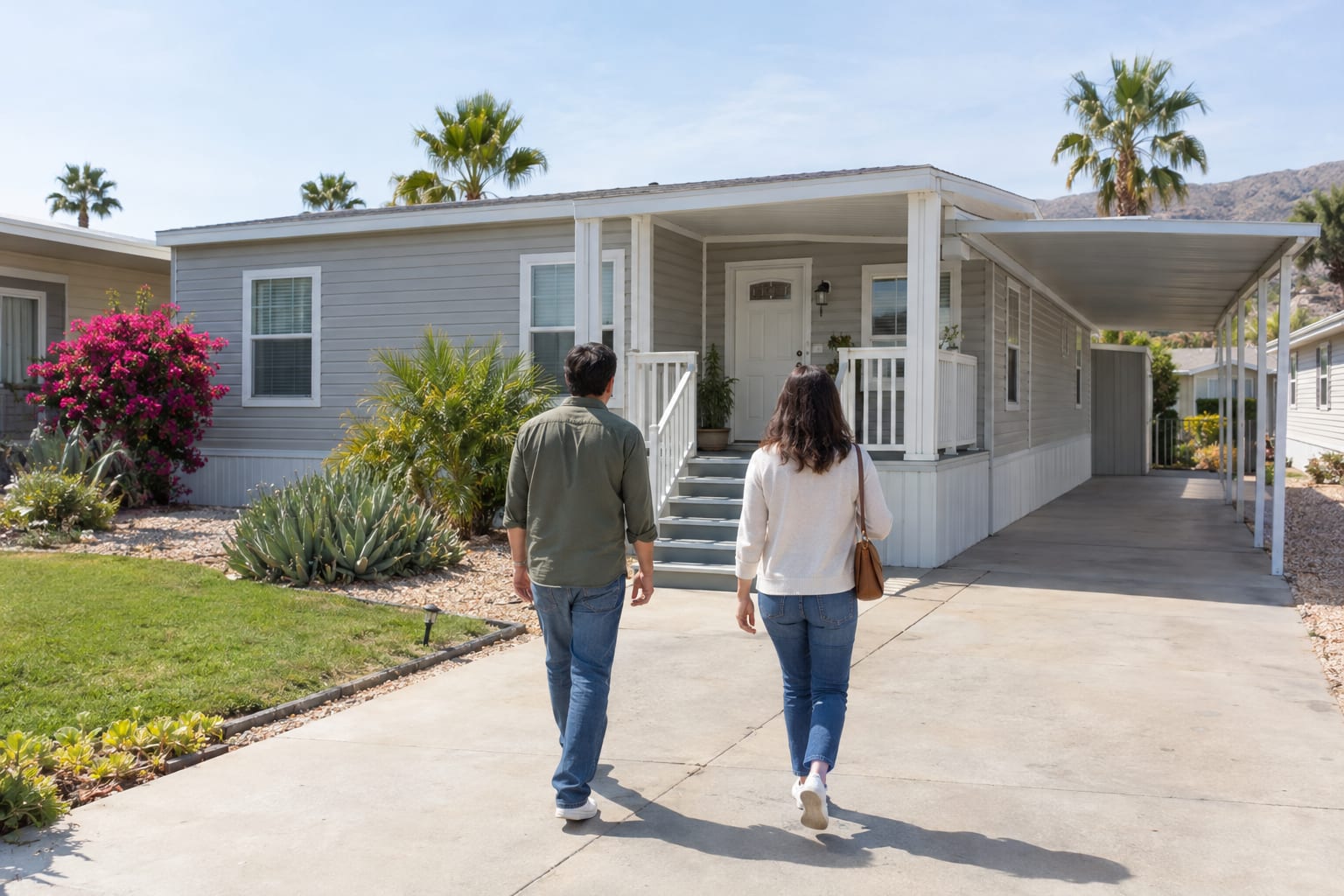
It pays to buy a mobile home in a set order. Decide first where the home will sit, because a home on rented space in a community and a home on land you own are financed differently. Then set a budget around the full monthly cost, get pre-qualified, check the home and its title before you make an offer, and let the lender, escrow and, for a community home, the community’s own review all finish before you move.
Decide where the home will sit before you shop
There are two setups, and each one changes the loan, the paperwork, the monthly cost and who has to approve the sale.
A home in a community compared with a home on owned land
| Home in a land-lease community | Home on land you own | |
|---|---|---|
| What you own | The home. You rent the space it sits on. | The home and the land. |
| How it is usually financed | On its own, as personal property | Often with the land, as real property, once the home is permanently affixed and recorded |
| Paid on top of the loan | Space rent and any community fees | Property taxes, and road, well or septic upkeep where they apply |
| Who else reviews the sale | The community, through its resident application | No community, but the land title and the foundation or affixture records are checked |
A home in a community is financed with a home-only loan, which you will hear called a chattel loan. For many buyers it is what makes the purchase possible at all, since the land is not for sale. A home on owned land can usually be financed together with the land, which adds land title work and an appraisal of both. If you are buying the land as well, or placing a home on land, read about land-and-home financing.
The questions to settle are different for each setup. Work through the questions to ask before buying on leased land, or the financing questions for a home on owned land. If you are not sure which applies, find your financing path asks three questions and points you to the right one. How mobile home loans work explains each kind of loan in more detail.
Set your budget around the full monthly cost
The sale price is only part of what you will pay each month. In a community, add space rent, insurance, utilities, community fees, taxes or registration charges, and a reserve for upkeep to the loan payment. On owned land, add property taxes, insurance, utilities and the upkeep of any road, well or septic system.
That is why space rent belongs in the budget from the start, not after you have chosen a home. How space rent affects what you can afford shows how to compare communities on it. To see the whole monthly picture with your own figures, use the payment calculator. Its results are educational estimates, not a loan offer.
There is no single down payment. It depends on the program, your credit, the home, and whether the land is leased or owned. Set aside money for closing costs too, and keep some cash back for moving and the first months in the home.
Get pre-qualified before you tour homes
Pre-qualification is an early review of your income, debts and credit that gives you a realistic range to shop in. It lets you tour homes you can actually pursue, and it tells you early if something needs work. Pre-qualification is not final approval: the loan is decided after you apply, once the home, its value and its title are known. Pre-qualification and pre-approval explains the difference.
Credit requirements vary by program and investor. Ask what applies to your scenario, and read preparing your credit for a mobile home loan application if you want to check your reports first. Free reports are available at annualcreditreport.com.
The document guide explains why each item is asked for. Once you have applied, avoid opening new credit or changing jobs without talking to your loan processor first. All financing is subject to credit approval, and not all applicants or homes qualify.
Find the home, then check what it is
Most problems that stall a mobile home purchase were visible on the first tour: the home’s age, how many sections it has, whether it was moved, and who holds the title. Write them down while you are there.
The before-you-shop checklist has these questions and a one-page worksheet you can print and take along. If the labels are hard to find, where to find the HUD label, data plate and serial number shows where each one usually is. For a home built before June 15, 1976, ask early whether financing is available; buying a mobile home built before 1976 covers what to check.
Who you buy from changes the paperwork. A dealer usually handles the title transfer and delivery, while in a private sale more of that falls to you, the seller and escrow. Dealer and private-party purchases compares the two.
An inspection and a value review are different checks. Your own inspection tells you about the home’s condition. The lender’s appraisal or comparable-sales review supports the home’s value. Inspection versus appraisal explains what each one covers.
Confirm the title before you make an offer
A manufactured home’s title is held by a state agency, and a title problem is better found before you are under contract than after. California titles and registers manufactured homes through HCD, the Department of Housing and Community Development, not the DMV (HCD registration and titling). Arizona titles are handled by the MVD, the ADOT Motor Vehicle Division, generally one title per section (ADOT mobile home ownership).
For a home on owned land, the records that tie the home to the land matter too.
In California, HCD Form 433A is used to report the installation of a manufactured home on a foundation system and is recorded with the county when applicable. It is an important property record, but it does not by itself guarantee financing.
In Arizona, for an eligible home permanently attached to land the homeowner owns, the Affidavit of Affixture process generally involves surrendering the MVD title and recording the affidavit with the county. Current procedures should be confirmed with MVD and the county.
California HCD title basics and Arizona title basics go further. This is general information, not legal or tax advice. If you have a home in mind and the title raises questions, talk with a specialist before you make an offer.
Make an offer that protects your deposit
The purchase agreement should say what happens to your deposit if the sale cannot close. Contingencies are the conditions that let you cancel under the terms of the agreement, and the usual ones cover financing, an inspection, the home’s value, and for a community home, the community’s resident approval. Deposits and contingencies explains each one and what to ask before you sign.
Apply to the community and the loan at the same time
If the home is on leased land, the community runs its own resident application. It is a separate review from the loan, with its own criteria, and the closing needs both approvals. Starting the community application as soon as your offer is accepted keeps it from becoming the last thing the file waits for.
Ask the community about its rules before you commit: age rules for 55-and-over communities, pets, parking and guests, any standards for a home’s age or appearance, and whether the home can stay when you sell it later. Passing community resident approval covers the application, and how park rules affect a purchase covers the rules that matter most.
From approval to the keys
- Clear the conditions An approval comes with a list of the documents and steps needed before the loan can fund. You return them; your loan processor tracks what is still open.
- Support the value Comparable sales or an appraisal support the home’s value, or the value of the home and land together. You provide access if a visit is needed.
- Arrange insurance You choose a homeowners policy that names the lender. The manufactured home insurance team at Santiago Financial, Inc. can quote one.
- Settle the title and escrow Escrow holds your deposit, the title is verified through HCD or MVD, and any loan on the home is paid off at closing.
- Review and sign Once every condition is cleared, loan documents are drawn and you sign with escrow or a notary. What to review before you sign lists what to read first.
- Fund and take the keys The loan funds through escrow, the title transfers to you, and you get the keys. For a community home, the community office handles move-in.
Timing depends on your transaction and the third parties involved: appraisal scheduling, community approval, title questions and missing documents are the usual reasons a file waits. Do not schedule the move until closing is confirmed. How the loan process works describes each stage after you apply, and the first-month paperwork checklist covers what to keep once the home is yours.