HUD Label, Data Plate, and Serial Number: What They Are and Where to Find Them
Every manufactured home transaction — purchase, refinance, insurance, title transfer — eventually comes down to three identifiers: the HUD label, the data plate, and the serial number. Buyers hear all three terms in their first week of shopping, usually without anyone explaining them. Here is what each one is, exactly where to look, and why they matter to financing.
Santiago Financial, Inc. has financed manufactured and mobile homes for over 50 years — today in California and Arizona — and confirming these three identifiers is one of the first things we do on every file.
The three identifiers at a glance
- HUD label — a small metal plate outside the home certifying it was built to the federal HUD Code. One per section.
- Data plate — a paper sheet inside the home listing the manufacturer, serial number, build date, and design zones. One per home.
- Serial number — the factory’s identifier for the home, stamped into the steel frame and printed on the data plate. One per section.
A double-section (“double-wide”) home therefore has two HUD labels, two serial numbers, and one data plate. In Arizona, it commonly has two titles as well — one per section.
The HUD label: the metal plate outside
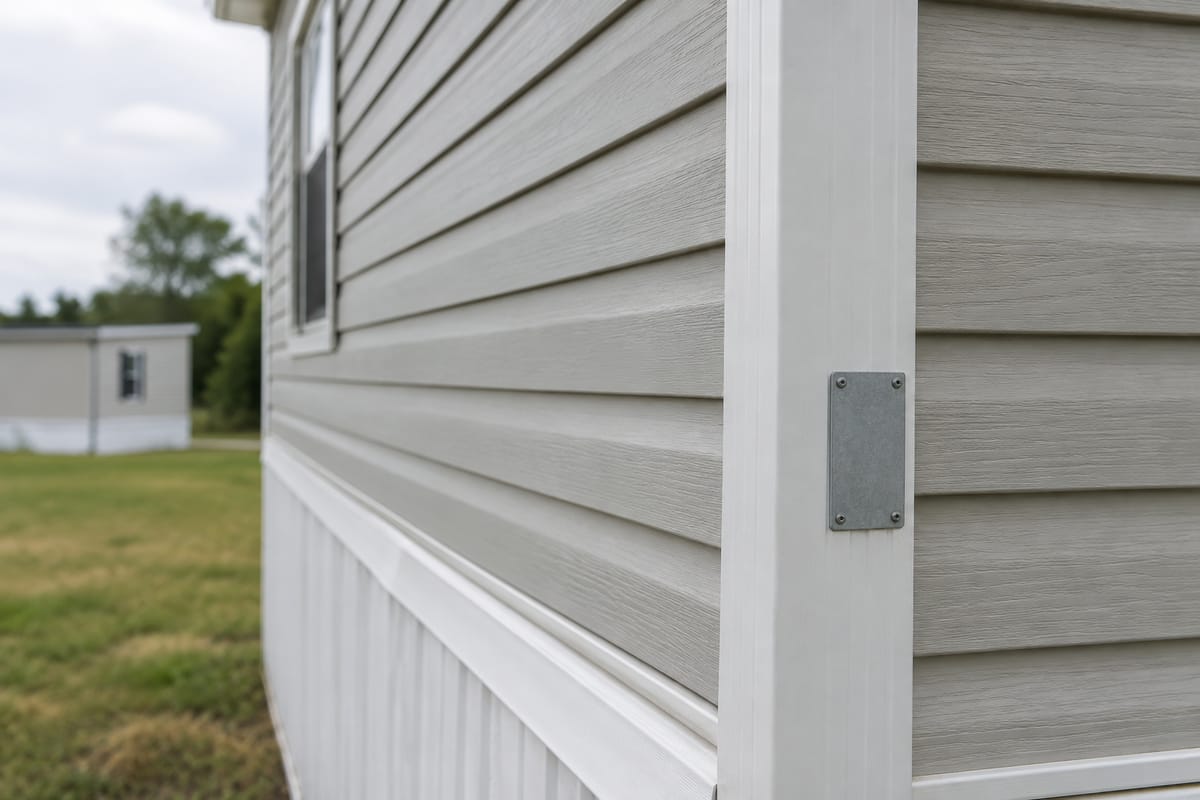
The HUD label — people also say HUD tag — is a small metal certification plate, about the size of an index card, riveted to the exterior end wall of each section, usually a foot or so up from the bottom edge. It carries a stamped label number (three letters followed by digits) and certifies that the section was manufactured to the federal Manufactured Home Construction and Safety Standards — the HUD Code — which took effect June 15, 1976.
Two practical notes:
- Homes built before June 15, 1976 have no HUD label, because the standard didn’t exist yet. That’s the technical line between a “mobile home” and a “manufactured home,” and it’s a fact lenders always establish early.
- Labels are sometimes painted over or missing. Paint is fine — the stamped number usually still reads. A missing label is not automatically fatal: verification letters can be ordered through the Institute for Building Technology and Safety (IBTS) using the home’s other identifiers. Flag it early rather than hoping nobody asks.
The data plate: the paper sheet inside
The data plate is a paper information sheet mounted inside the home. Look for it, in roughly this order:
- Inside a kitchen cabinet (often the one under the sink or an upper door)
- On or near the electrical panel door
- In a bedroom closet
- Near the back door or in the utility area
It lists the manufacturer, plant, model, serial number, date of manufacture, the HUD label numbers for each section, and the wind, snow (roof-load), and thermal zones the home was designed for. Those zone maps matter more than people expect — they’re how an appraiser or installer confirms a home is appropriate for where it sits.
If the data plate is missing (they occasionally disappear in remodels), the same IBTS verification route can reconstruct the information.
The serial number: stamped in steel
The serial number — sometimes loosely called the home’s VIN — appears in two places:
- Printed on the data plate, and
- Cold-stamped into the steel frame, typically on the frontal cross member near the hitch end of each section. Finding it may mean looking under the home near the tongue with a flashlight.
Multi-section homes have one serial number per section, usually identical except for a trailing letter (…A, …B). Title records, registration, tax rolls, insurance policies, and loans all reference this number, which is why a digit-perfect match between the physical home and the paperwork matters. A transposed digit on a decades-old title is a classic — and fixable — source of closing delays.
Why lenders ask for these on day one
When we ask a buyer for the HUD label or serial number, we’re doing three things at once:
- Confirming what the home is — HUD-Code manufactured home vs. pre-1976 mobile home vs. modular — because that determines which programs can apply.
- Matching the home to its title. In California, titles run through HCD; in Arizona, through the MVD, generally one per section. The serial number is the thread that ties the physical home to those records.
- Catching problems while they’re cheap. A missing label, a mismatched digit, or a title still in a prior owner’s name can all be cured — but curing takes weeks, and it’s far better to start in week one than week five.
Touring homes? Capture these as you go
You don’t need to crawl under a home during a showing. Ask the seller to point out the data plate, photograph it, and note the year, manufacturer, and sections. That single photo carries almost everything a financing conversation starts with. Our Before You Shop worksheet has a line for each of these, and the glossary defines every term in this article.
You may also want to know:
- What to capture before you shop for a manufactured home
- What is a 433A and why does it matter in California?
- Arizona’s Affidavit of Affixture, explained
Ready for the next step? Estimate a payment (educational estimates, not offers) or talk with a specialist who has read a few thousand data plates.
Available programs and terms depend on borrower qualifications, property characteristics, loan amount, home location, land ownership, and lender guidelines. All financing is subject to credit approval. Label and record verification processes are administered by the agencies and organizations that maintain them; details can change.