Preparing Your Mobile Home for Summer Heat: HVAC and Insulation Checklist
Get the cooling system serviced and the rest of the home checked in spring, before the first stretch of extreme heat. In the Arizona deserts and California’s inland valleys, air conditioning is the one system you cannot go without in July, and the worst day to find a problem is the day it stops.
The checklist below applies to a pre-1976 mobile home and a newer manufactured home alike, though older homes usually need more of it. It ends with something most lists leave out: a plan for the day the power or the air conditioner fails.
The pre-summer checklist
Service the cooling system before the heat arrives
Start here, and start early, while a problem is still a routine repair and not an emergency.
Find the filter and check it monthly
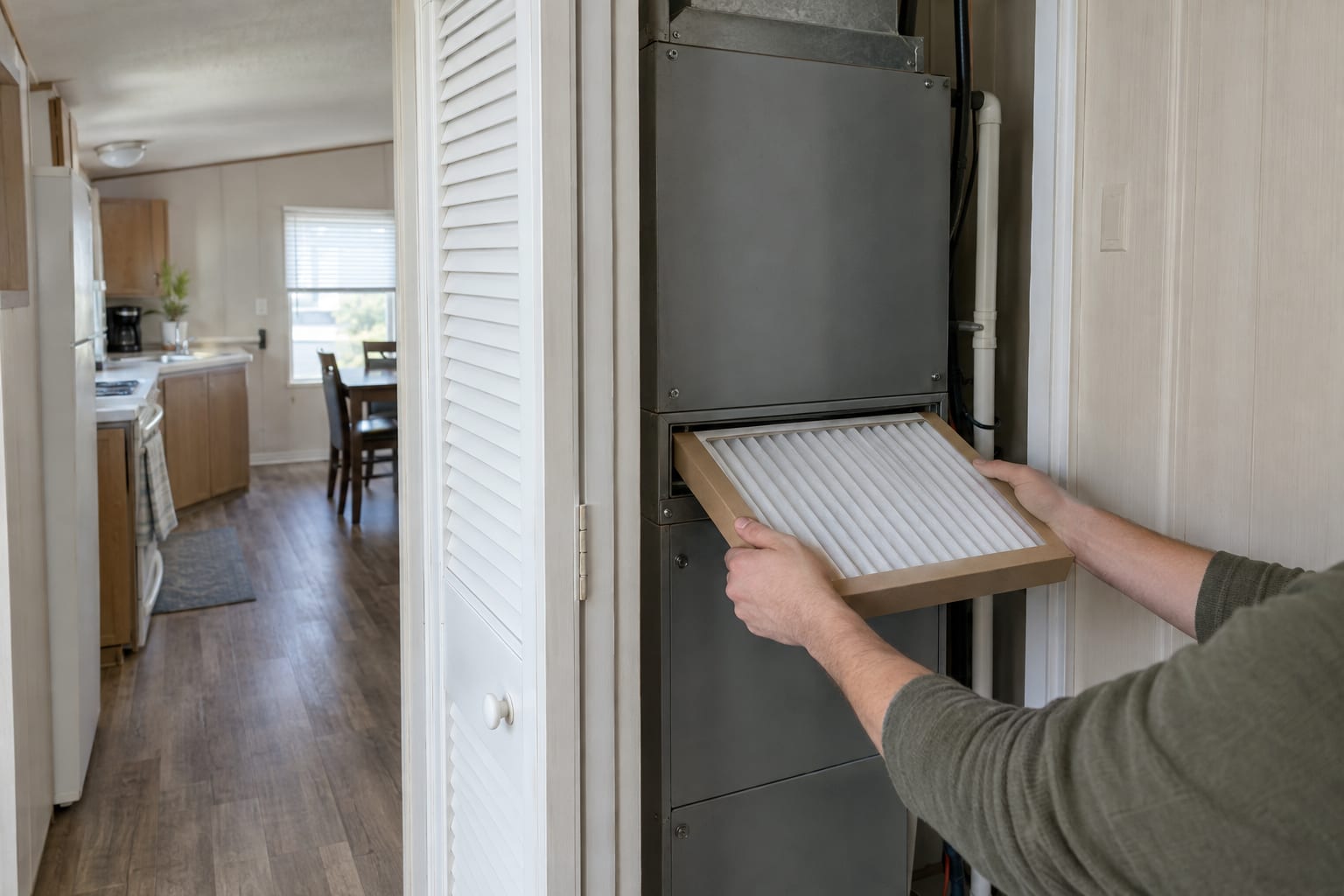
In most manufactured homes the furnace and air handler sit in a hallway closet behind a louvered door, and the filter is in that closet instead of behind a ceiling or wall grille. Find it and write down the size printed on its frame, so you can buy the right replacement before you need it.
ENERGY STAR’s heating and cooling guidance is to check the filter every month during heavy use and change it when it is dirty, at least every three months. In dust-storm country, expect to change it more often than that.
Book the tune-up in spring
Ask what the tune-up includes. ENERGY STAR’s maintenance checklist lists what a technician should do: clean the evaporator and condenser coils, check the refrigerant level, inspect the condensate drain, tighten the electrical connections, and check the blower and the controls. Ask for a technician who works on manufactured homes, since the furnace and the duct layout differ from a site-built house.
Clear the outdoor unit
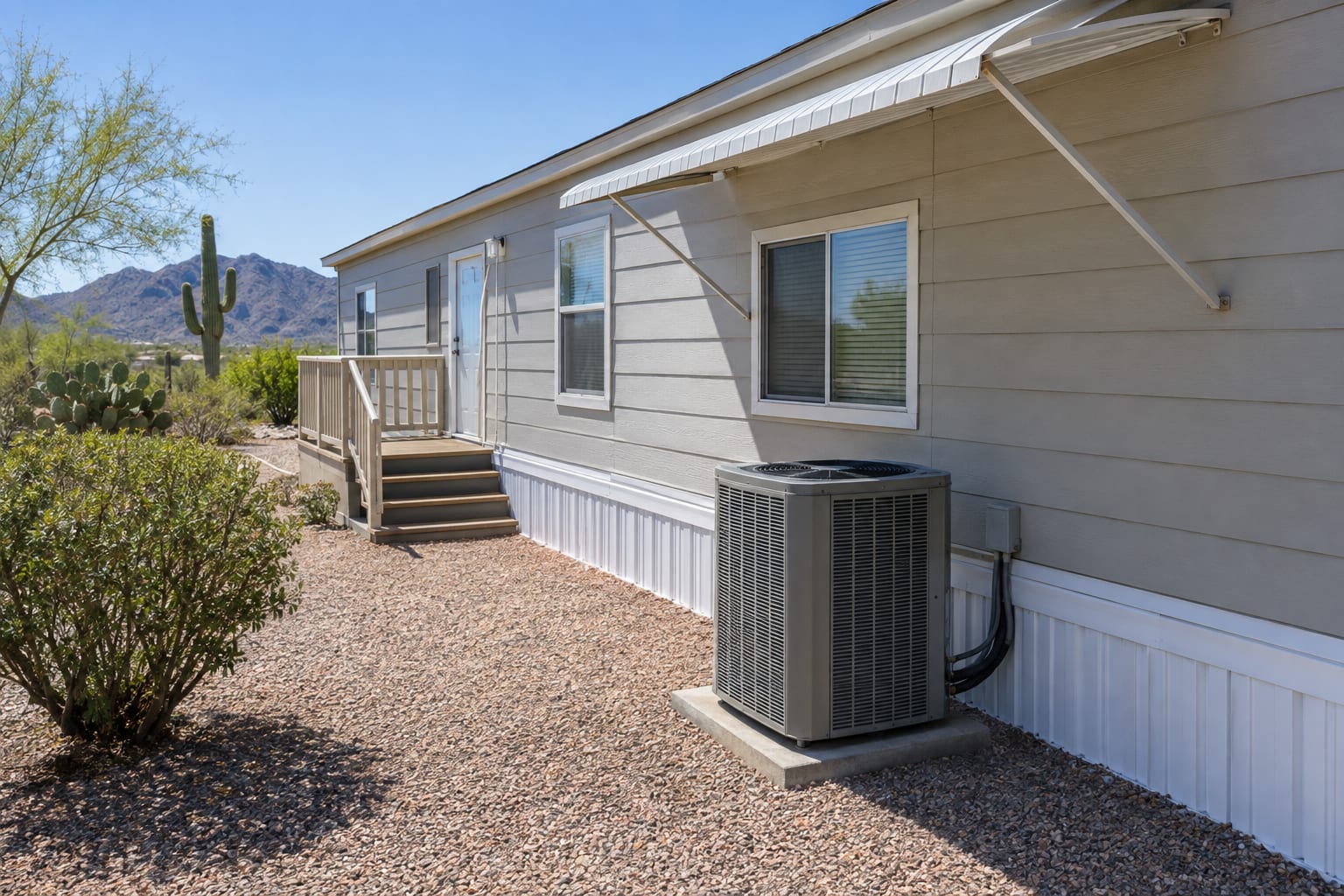
The condenser gets rid of heat by pulling air through its sides and blowing it out the top. Clear away leaves, weeds and anything stored beside it. Shade from an awning or a tree is fine. A cover, a fence panel or a shrub close enough to block the airflow is not.
If the home has an evaporative cooler
Some older homes in the desert and the Central Valley have an evaporative cooler, also called a swamp cooler, on the roof or in a window. At the start of the season, replace the pads, clean the water pan, and check the float valve, the pump and the belt, following the maker’s instructions. While you are there, look at the roof around the cooler’s stand for cracked sealant.
Replacing equipment is also a permit question. In California, HCD’s alteration guidelines list installing or replacing an air conditioner as work that needs a permit. In Arizona, ask the Arizona Department of Housing. This is general information, not legal advice.
Take a flashlight look at the ducts and the belly
In a manufactured home the ducts run under the floor, inside the belly wrap that closes the underside of the home. A double-wide also has a crossover duct, a large flexible duct beneath the home that joins the two halves. If it has torn, sagged to the ground or pulled loose, you are paying to cool the space behind the skirting.
Indoors, the signs are a room that never cools, weak airflow at the registers farthest from the furnace, or one half of a double-wide that is always warmer. Outside, take off the skirting access panel and look in with a flashlight:
- the crossover duct connected at both ends and held up off the ground
- the belly wrap whole, with no insulation hanging down
- skirting panels all in place, and their vents left open; the space under the home still has to breathe in summer
Then lift each floor register, vacuum the opening, and make sure no rug or piece of furniture covers it. Duct and belly repairs are work for a contractor. How to improve energy efficiency in a manufactured home explains what those repairs involve and which upgrades are worth doing first.
Check the roof coating and the shade
On a low-slope metal roof, the white reflective coating does two jobs: it seals the seams and it reflects sunlight. Look at it in spring from a ladder at the eave. If it is chalky, thin, cracked or peeling, re-coat before summer, and follow the product’s instructions on surface preparation and temperature. In California, HCD’s alteration guidelines treat re-roofing as permit work but say that does not include applying a liquid roof coating. On a shingle roof, look for lifted or missing tabs and cracked sealant around the vents instead.
At the windows, Ready.gov’s extreme heat guidance is to cover windows with drapes or shades, use window reflectors, and weather-strip doors and windows. Shade on the outside does even more, because it stops the heat before it reaches the glass. Awnings and sun screens on the west and south sides are the usual choices.
Get awnings and carports ready for summer storms
In Arizona, summer also brings the monsoon. The National Weather Service office in Phoenix says thunderstorm gusts in the Southwest almost always exceed 40 mph, and lists dust storms and flash floods among the season’s hazards on its monsoon safety page.
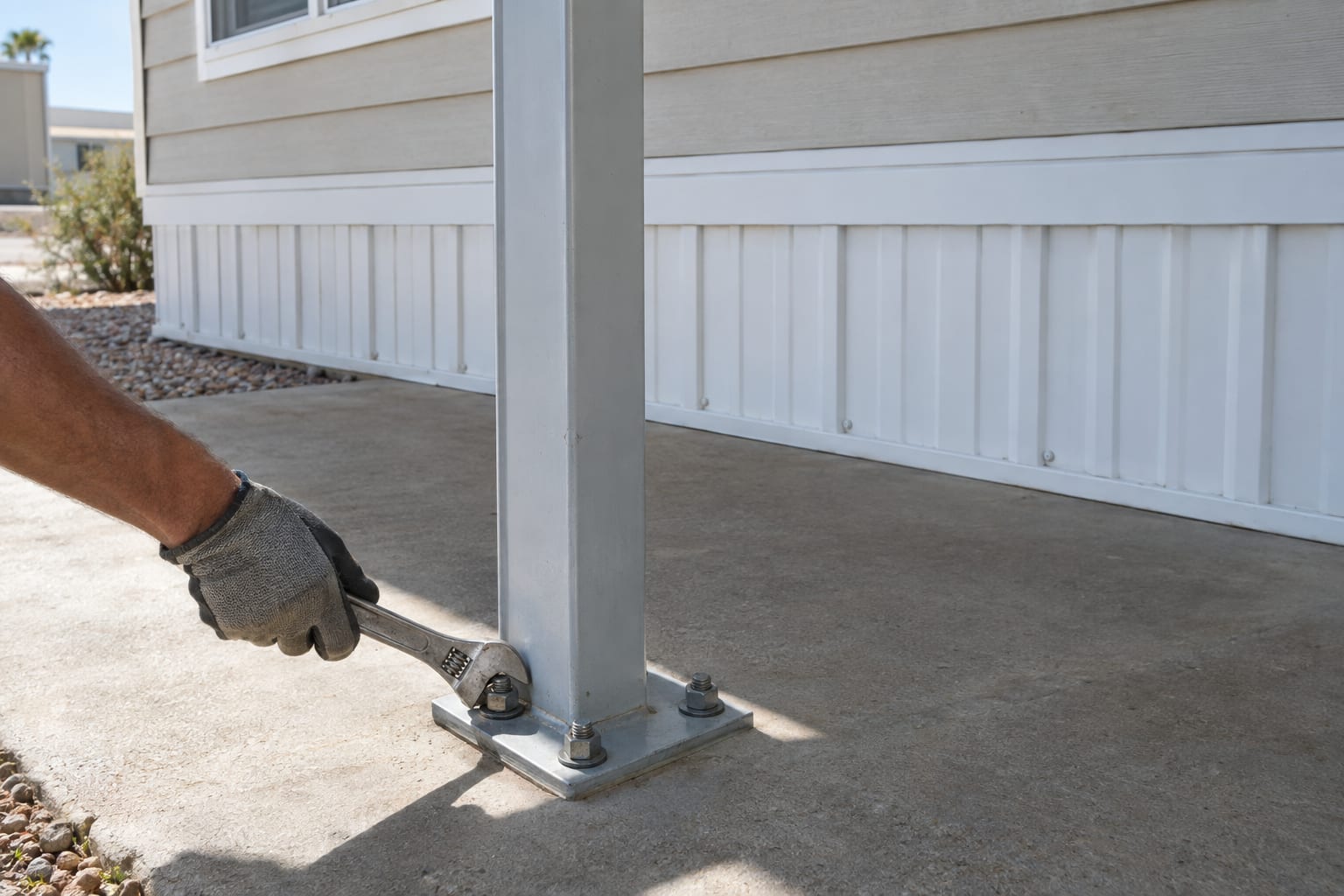
On a manufactured home, wind finds the awnings and the carport first. Before the storms start, check each post for a rusted or loose base, tighten the fasteners where the awning meets the home, and clear the awning gutters. Put away or tie down anything light enough to blow into a neighbor’s home. After a dust storm, check the filter and look at the outdoor unit again.
Plan for the day the cooling or the power fails
A home with a metal roof and little shade warms up soon after the cooling stops, so decide what you will do before it happens.
- Know where you will go. Ready.gov’s advice when a home has no working air conditioning is to find a cooling center. A relative’s home or a public library also works. The Arizona Department of Health Services links to a map of cooling centers from its heat safety page.
- Do not rely on a fan. Ready.gov warns that a fan creates airflow and a feeling of comfort but does not lower body temperature or prevent heat illness.
- Slow the heat down. Close blinds and curtains on the sunny side, drink water before you feel thirsty, and take a cool shower.
- Check on neighbors, especially older residents who live alone. The National Weather Service describes the warning signs of heat illness.
- In a power outage, keep the refrigerator closed, and plan ahead for medicines that need refrigeration and for medical devices that need power. Switch the air conditioner off at the thermostat until the power is steady again, because power can return with surges.
- Run a portable generator outdoors only. Ready.gov says at least 20 feet from windows and doors. Spaces in a community are close together, so that distance applies to your neighbor’s windows too.
- Keep two numbers handy: your cooling contractor and the community office.
If the home will sit closed all summer, the list is different. Buying a manufactured home as a snowbird in Arizona covers closing a home for the season, and the year-round maintenance guide shows where summer fits with the rest of the year.