
Choosing a Manufactured Home Community Near San Diego: A First-Time Buyer's Guide

Local financing details: Mobile Home Loans in San Diego
The right manufactured home community for a first-time buyer in San Diego County is the one where the full monthly cost fits your income, the rules fit how you live, and the community accepts you as a resident. No ranked list can settle those three for you, because rent, rules and openings differ from space to space and change over time.
What works is to narrow the county to an area, then check every community you consider the same way: its public record, the city’s rules on space rent, the hazards at the address, and the answers you get at the office.
What you are choosing when you choose a community
In a community, often called a mobile home park, you buy the home and rent the space under it. The community is your landlord for the land, so you are choosing three things at once.
- A monthly rent. Space rent is paid on top of the loan payment, and a lender counts it when reviewing your income. How space rent affects what you can afford shows how to compare two communities on the full monthly cost.
- A set of rules. Age limits, pets, vehicles, guests, subletting and changes to the outside of the home are all set by the community.
- A second approval. The community reviews you as a resident, separately from the lender. Passing community resident approval explains what that review usually asks for.
You may hear that a park “allows” or “does not allow” financing. A community does not approve your loan, and a lender does not approve your residency. In California the lender’s lien is recorded on the home’s title record with the state housing department, HCD, and the park plays no part in that. What the community does affect is what the lender reviews: the space rent, the rental agreement, and the community’s own decision on your application.
If the whole process is new to you, the first-time buyer’s order of events covers the steps from pre-qualification to closing.
Start by choosing a part of the county
San Diego County runs from the beach to the foothills, and the same budget buys a different set of tradeoffs in each part. Decide where you need to be for work and family first. Then look at what is particular to that area.
Areas of San Diego County and what to look into in each
| Area | Local page | What to look into there |
|---|---|---|
| City of San Diego | San Diego | Runs from the coast to inland mesas, so check each address, not the city name |
| North County coast | Oceanside | Salt air, coastal hazard maps, the city’s space-rent rules |
| Inland North County | Escondido and San Marcos | Summer heat, wildfire maps, Escondido’s rent ordinance |
| East County | El Cajon | Summer heat and cooling costs, wildfire maps near the foothills |
| South Bay | Chula Vista | The city’s space-rent review, flood maps |
Close to the water, salt air and insurance come to the front. What living near the beach costs in a manufactured home covers both.
Inland, summer heat matters more. An older home with an ageing air conditioner can be expensive to cool, so ask the seller for a summer electric bill. The data plate inside the home usually shows the thermal zone it was built for.
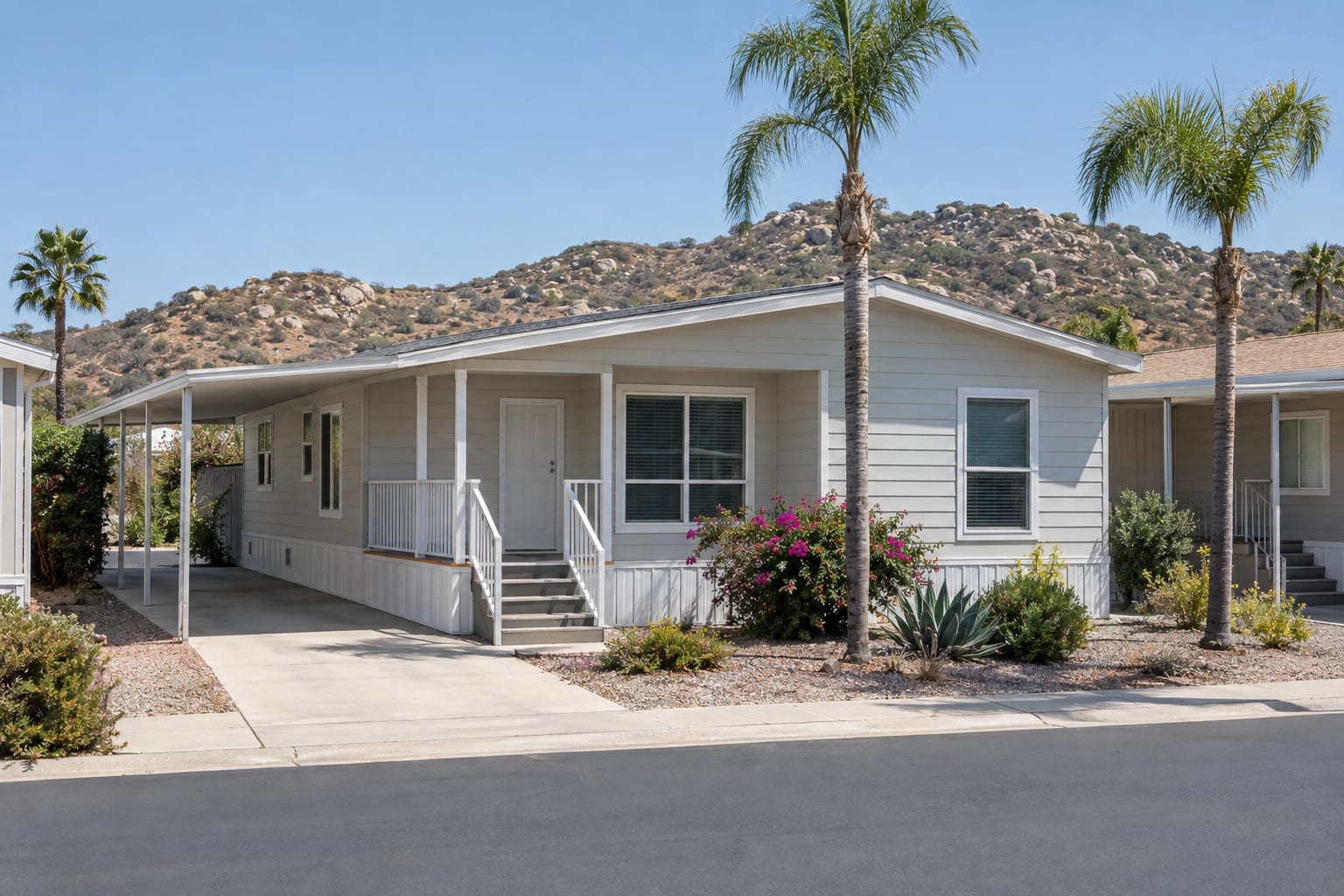
Space rent rules depend on the city the park is in
California’s Mobilehome Residency Law applies statewide. On top of it, HCD notes on its page about your rights as a mobilehome park resident that cities and counties often pass their own ordinances, including rent control. In San Diego County some cities have and some have not. Three that publish theirs:
- Chula Vista: the city’s mobilehome page describes space rent review under Chapter 9.50 of its municipal code.
- Oceanside: the Manufactured Home Fair Practices Commission acts under Chapter 16B of the city code.
- Escondido: Mobilehome Rent Control Administration covers the ordinance its voters passed in 1988.
Read the rules on those pages. They are not summarised here, because they change and because not every space in a city is necessarily covered. Ask the city office about the specific space you are considering. For a park in another city or in an unincorporated area, ask the city or county housing office what applies.
This matters to a buyer because the rent a community can charge, and how it may rise later, is part of what you are buying into. This is general information, not legal advice.
Look a community up before you visit
An hour at home will tell you whether a community is worth a visit.
Checking a community from home
- Find the park in HCD’s records Parks need a permit to operate. HCD’s mobilehome park search shows the state’s record for a park, including its address and the agency that enforces park standards there.
- Read the local rules Once you know which city the park is in, or whether it is in an unincorporated area, read that city’s page on space rent, if it has one.
- Look up the hazards at the address The FEMA Flood Map Service Center and the State Fire Marshal’s Fire Hazard Severity Zone maps both search by address.
- Call the office Ask whether the community is all-age or 55+, whether any homes are for sale, and how to get a copy of its rules and its resident application.
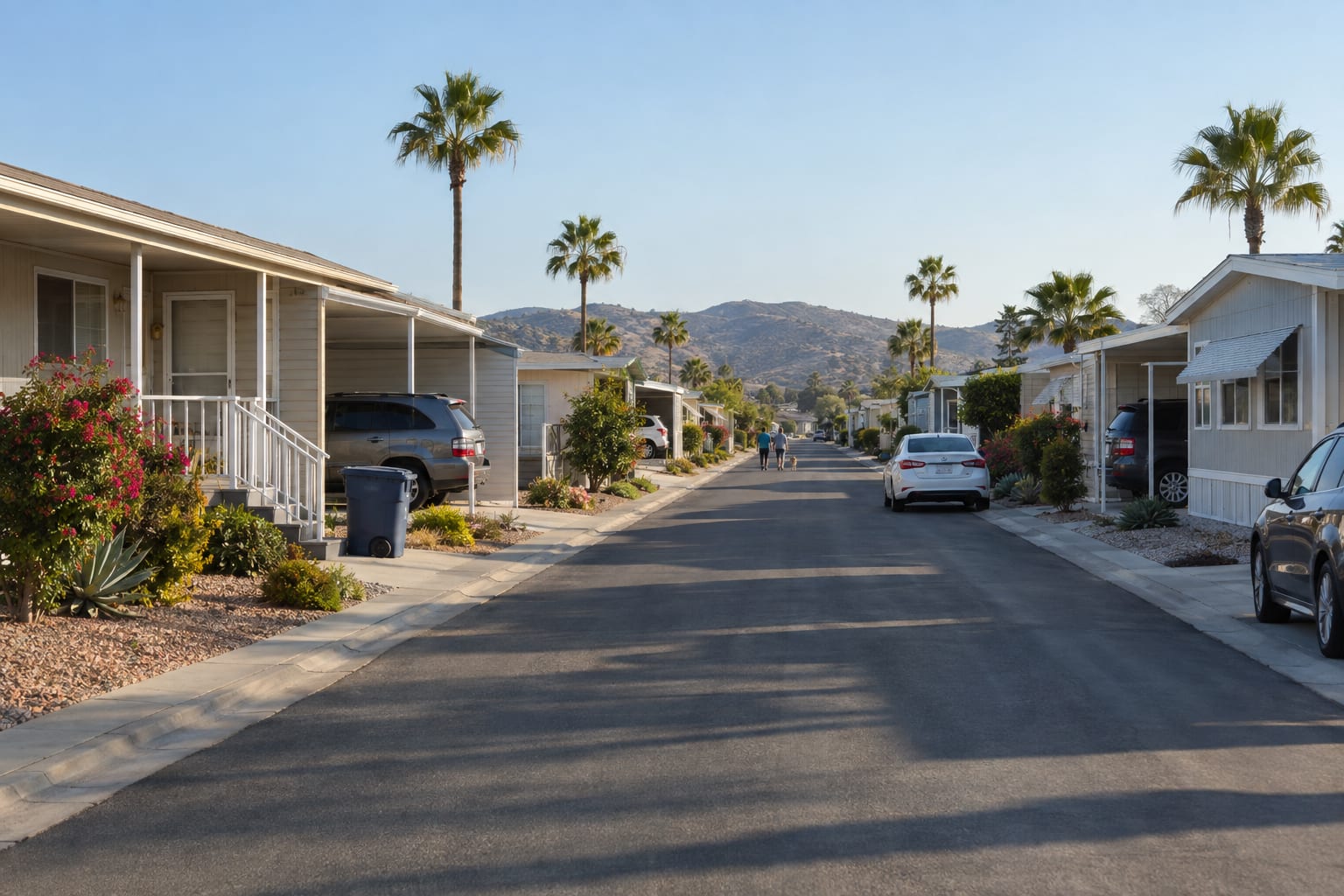
- Visit twice Go once on a weekday and once in the evening or at the weekend, when you can see the parking, the noise and how the streets are kept.
Rule out communities you cannot live in
Two rules remove a community from your list before rent comes into it.
The first is age. Some communities are restricted to older residents, usually described as 55+ or senior communities, and others are open to all ages. A listing does not always say which, so ask.
The second is how you plan to use the home. Some buyers use manufactured homes as rentals, but many programs and communities require owner-occupancy. Ask whether financing is available for your intended use before you buy.
Questions for your first visit
When one community stands out and you settle on a home there, ask for its application and tell your lender which community it is. Pre-qualification is not final approval, and the community’s decision is separate, so both need to be under way before you count on a closing date.