Buying a Manufactured Home From a Private Seller: Financing Steps Buyers Should Know
Financing a manufactured home you buy directly from its owner follows seven steps: get pre-qualified, check the price, verify the title, deal with any loan the seller still owes, clear community approval, close through escrow, and insure the home. No dealer is preparing the paperwork, so each step has a job for you and a job for the seller.
The things that stall a private sale can usually be checked before the offer: a co-owner who has to sign, a lien nobody mentioned, a community application sent in late. If you are still choosing between a private sale and a dealer home, dealer vs. private-party purchases compares the two.
The seven steps, and what you and the seller each do
Financing a private-party purchase
- Get pre-qualified before you make an offer You talk with a loan specialist and describe the home, where it sits and your finances. The seller does nothing yet. Pre-qualification is an early read on what may be realistic. It is not final approval.
- Check the price No dealer price sheet exists, so you compare the asking price with recent sales of similar homes. The seller tells you the year, the size and what has been replaced or added. For California communities, comparable sales reports list reported sales in a park. They are not appraisals.
- Verify the title The seller gives you and the lender a copy of the title or registration. You check that the seller’s name is on it, that every owner listed can sign, and whether a lienholder appears.
- Settle any loan the seller still owes The seller gives escrow the lender’s name and loan number. Escrow requests a payoff figure and pays it from the sale proceeds at closing.
- Apply to the community If the home is on leased land, you submit the community’s resident application, and the seller lets the office know the home is being sold. Start this as soon as your offer is accepted.
- Close through escrow You deposit your funds and sign the loan documents. The seller signs the title and the escrow instructions. Escrow pays off the old loan and pays the seller, and the transfer documents go to the state agency.
- Insure the home You choose a homeowners policy and give the lender proof of it before the loan funds.
Steps 3 to 5 overlap, and the loan review runs alongside them once you have applied. Timing depends on the transaction and the third parties involved: the community office, the seller’s lender and the state titling agency each work to their own schedule.
What each side brings
A dealer would assemble most of the file for you. Here it is split between two households, so it helps to agree early on who is fetching what.
Documents in a private-party purchase
| From you, the buyer | From the seller |
|---|---|
| Loan application, photo ID, income and asset documents | Title or registration in the seller’s name |
| Your signature on the purchase agreement | Their signature on the same agreement, and on the title at closing |
| The community’s resident application, if the home is on leased land | The lender’s name and loan number, if money is still owed |
| Proof of homeowners insurance | Permits or receipts for additions and major repairs, if they have them |
| Your deposit and down payment, paid into escrow | Access to the home for an inspection and any appraisal visit |
Verify the title first, because the rules differ by state
The title is the ownership document for a manufactured home held as personal property, similar in concept to a vehicle title. Which agency issues it depends on the state.
California. Titles and registration are handled by HCD (the Department of Housing and Community Development), not the DMV. The certificate of title shows the registered owner and, if a loan exists, the lender as legal owner. HCD generally asks for a tax clearance certificate from the county tax collector before it transfers a home that is on the local property tax roll, so ask the seller whether taxes are current.
HCD’s registration and titling pages list the transfer forms, and California HCD title basics explains what a buyer should look for on the title.
Arizona. Titles are handled by the MVD (the Motor Vehicle Division of ADOT), generally one title per section. A double-wide therefore has two titles, and both have to be signed over. If a lienholder is shown, a lien release is needed as well. ADOT’s mobile home ownership page describes the transfer, and Arizona title basics covers what buyers and sellers should check.
In either state, compare the serial number on the title with the one on the home’s data plate, the paper sheet mounted inside the home, often in a kitchen cabinet or a bedroom closet. A multi-section home has one serial number per section.
A home that sits on land the seller owns may have been converted to real property, through a recorded HCD Form 433A in California or an Affidavit of Affixture in Arizona. In that case the home generally transfers with the land by deed, and the purchase works like a real estate sale. Tell your loan specialist which situation you have, because it decides which kind of loan applies. This is general information, not legal or tax advice; confirm current procedures with HCD, the MVD or the county.
When the seller still owes money on the home
An existing loan does not stop a sale. The seller’s lender is shown on the title, and the home cannot transfer free of that lien until the loan is paid. Escrow, the neutral third party that holds funds and documents until every condition is met, asks the lender for a payoff figure, pays it from your purchase funds at closing, and obtains the release.

Ask about a loan before you agree on a price. If the seller owes more than the price you settle on, the seller has to cover the difference at closing, and it is better for both of you to learn that at the start.
Community approval is a separate decision
A home in a land-lease community comes with a second review. The community’s management decides whether to accept you as a resident under its own criteria, and the lender decides whether to finance the home. Passing one does not settle the other, and closing needs both. How community resident approval works covers what communities usually ask for.
While you are at the office, ask for the current space rent and the lease or rental agreement in writing, and ask whether the community requires anything of the home itself when it changes hands.
Before you make an offer
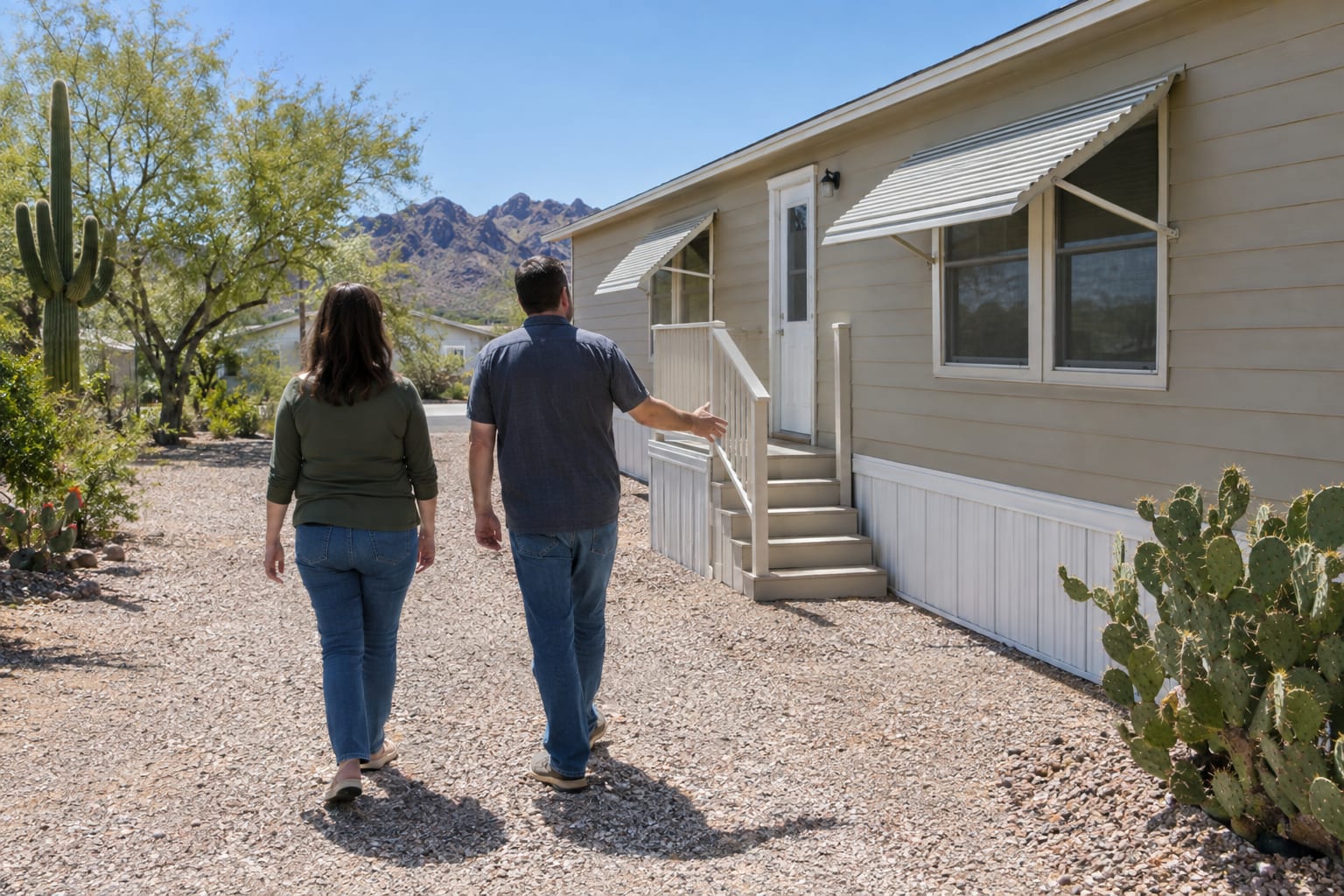
Walk the home with the owner and go through the list below while you are both standing in it. The title and any loan on the home are the two things only the owner can show you, so ask to see them then.
All financing is subject to credit approval, and not every home or applicant qualifies. Ask that your purchase agreement make the sale depend on financing, community approval and an inspection you are satisfied with, so you can step back if one of them does not come through.