
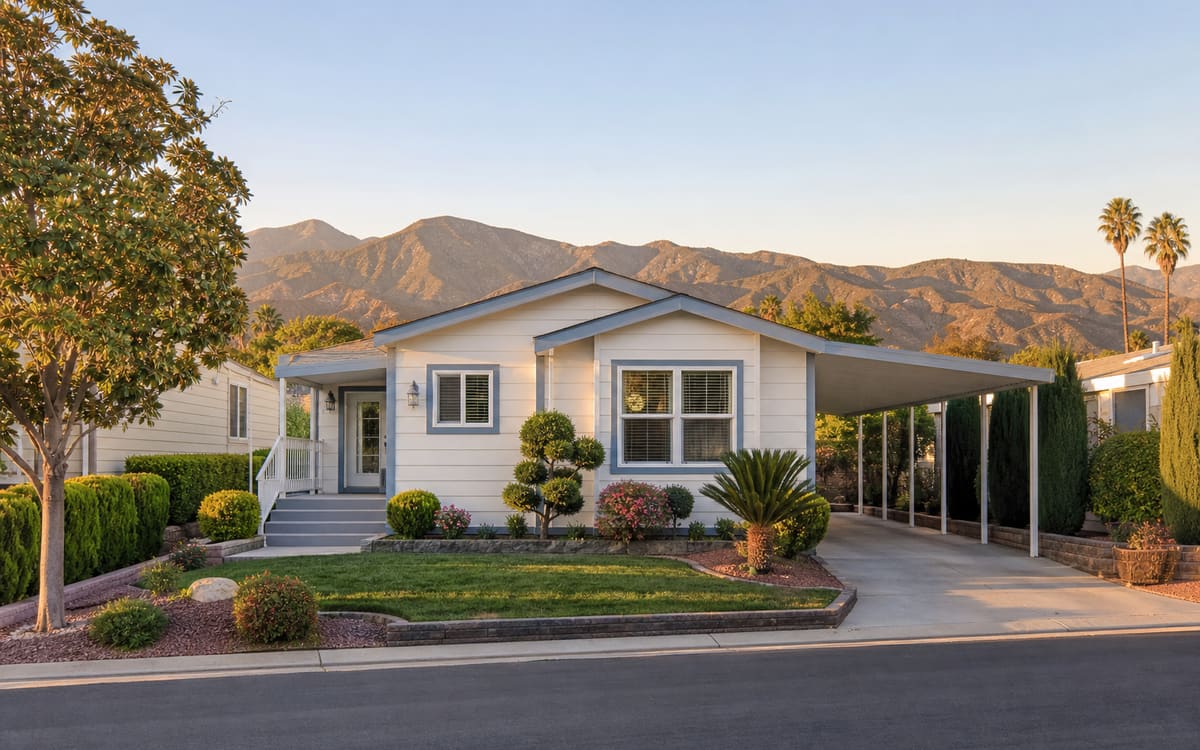
Corona is the first city on the Riverside County side of the Santa Ana Canyon, so many buyers arrive comparing it with Orange County. The financing does not change at the county line: a manufactured home in Corona is titled through HCD like one in Anaheim, a home in a park is financed on its own as personal property, and Santiago Financial, Inc. lends in both counties from its office in Tustin. What changes is who makes the local rules, and in Corona those rules changed recently.
Three of them matter most: the city adopted its own mobilehome park rent ordinance at the end of 2025, its hillside edges carry fire hazard zones that add a step to a sale, and several pockets inside and around the city are unincorporated, so a park or a lot there answers to Riverside County instead. The California hub page covers the statewide basics; this page covers Corona.
Corona now has its own mobilehome rent ordinance
The Corona City Council adopted a Mobilehome Park Rent Stabilization Ordinance on December 3, 2025, effective January 2, 2026. The city says it applies only to mobilehome parks, and its page carries the ordinance, park-by-park notices and a list of questions and answers.
The ordinance stops at the city line. Coronita and Home Gardens are county islands surrounded by or beside the city, El Cerrito and Temescal Valley lie to the south along the 15, and Riverside County’s planning documents describe all of them as unincorporated communities. A park there comes under the county’s Mobile Home Park Rent Stabilization Ordinance, Ordinance 760, which exempts spaces in parks built after January 1, 1990, and spaces first rented after that date. Norco and Eastvale are separate cities with their own policies.
Neither ordinance tells you what a space costs. Ask the park for the current rent, what it includes and how it has changed, and ask the city or county which rules apply. Statewide, park tenancies come under California’s Mobilehome Residency Law, and HCD runs a Mobilehome Residency Law Protection Program for certain disputes between homeowners and management.
Who sets the park rules around Corona
| Where the park is | Whose rules | Where to check |
|---|---|---|
| Inside the City of Corona | The city’s 2025 rent stabilization ordinance | The city’s housing office |
| Coronita, Home Gardens, El Cerrito, Temescal Valley | Riverside County Ordinance 760, with exemptions for newer parks and spaces | Riverside County Housing and Workforce Solutions |
| Norco, Eastvale | Each city decides its own policy | That city’s clerk or housing office |
The hills add a fire-zone step to a Corona sale
Corona has its own fire department, and the state’s 2025 Fire Hazard Severity Zone maps for the city’s local responsibility area divide mapped ground into Moderate, High and Very High. The Corona Fire Department links the state map viewer and explains how the city adopts the maps.
The zone matters at sale, not only for insurance. The fire department’s AB 38 property sales page explains the state rule: sellers of property in a High or Very High zone must obtain a defensible space compliance inspection from Corona Fire before the sale closes and give the buyer documentation of compliance; if it is not done by closing, buyer and seller agree in writing that the buyer will obtain it within a year.
Ask the department whether the inspection applies to your sale, including a home in a park, and get a manufactured home insurance quote for the address before you make an offer, because a lender generally requires acceptable coverage before closing.
Summers are hotter than at the coast, and cooling belongs in your own budget even though a lender’s housing ratio leaves the electric bill out. NOAA’s 1991 to 2020 climate normals for Riverside Municipal Airport, the nearest long-term station, put the average July high at 93°F. Ask the seller for a year of electricity bills.
A lot in the unincorporated pockets is a different loan
A home in one of Corona’s parks is financed as personal property with a home-only or chattel loan, and the park’s resident approval is a separate review. A home sold with land is a different file.
The county’s Temescal Canyon Area Plan describes El Cerrito as a rural community with parcels from a quarter acre to several acres, and a home with land like that can often be financed as real property through land-and-home financing, which adds land title, a recorded foundation or affixture document, an appraisal of home and land together, and county permits rather than city ones.
Either way, the county recorder matters. HCD Form 433A is recorded with the Riverside County Assessor-County Clerk-Recorder when a home is installed on a foundation system, and the same office’s manufactured homes page explains which homes pay local property tax and which pay HCD’s in-lieu fee. Ask the seller which one applies before you make an offer.
Nearby areas
Across the canyon, Anaheim, Santa Ana and Tustin, where our office is, have their own pages. On the Riverside County side, Riverside runs a separate city rent program, and the guide to manufactured home areas of Riverside County compares the county’s regions. Homes in Norco, Eastvale and Temescal Valley are financed the same way; they do not need a page here.
Every application is reviewed individually, and all financing is subject to credit approval. Local rules change, so confirm them with the city or county; this page is general information, not legal or tax advice.